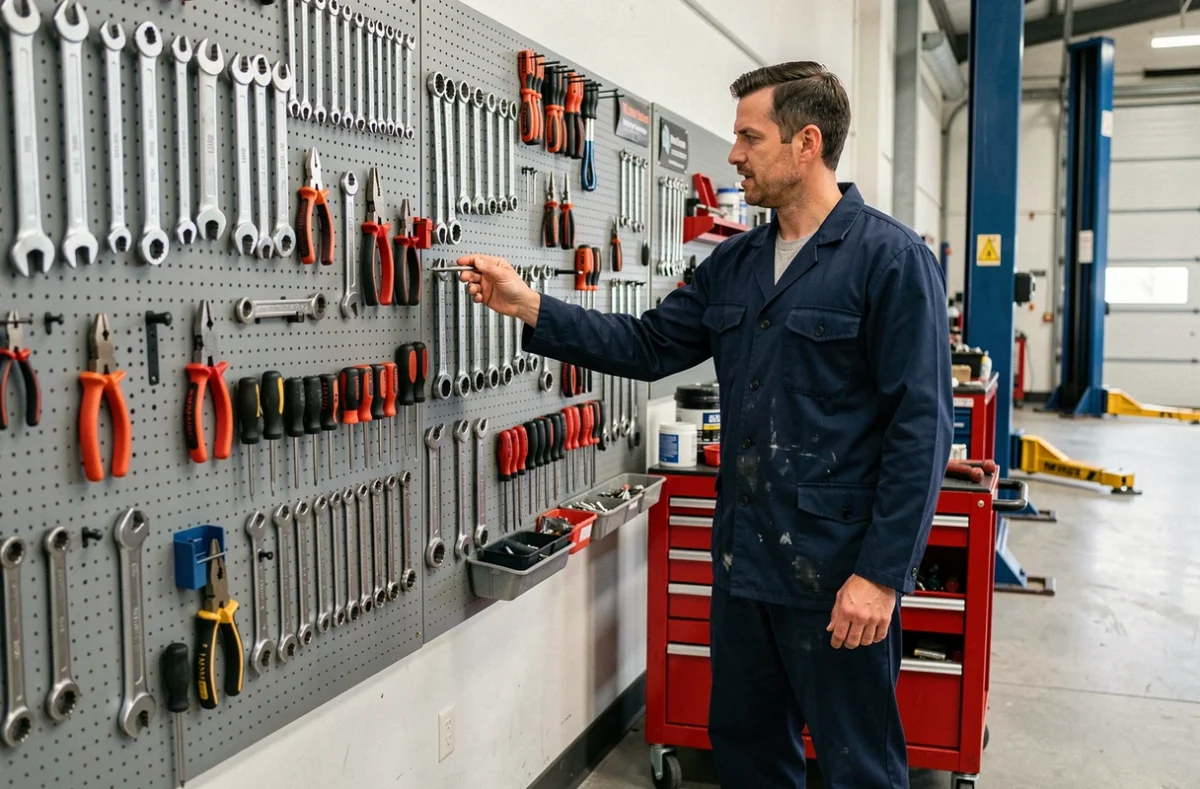
Equipping a workshop or a professional garage is not just about accumulating tools on a workbench. The real question is: which equipment positions create the most significant gap between a high-performing workshop and one that hinders its own interventions? The answers vary depending on the activity, the size, and the type of vehicles serviced, but certain trade-offs consistently emerge.
ADAS Calibration and Electrification: Areas Most Workshops Underestimate
The widespread adoption of driver assistance systems is transforming garage equipment needs. Interventions on cameras, radars, or lidars require calibration targets, dedicated platforms, manufacturer-compatible software, and complete traceability of each operation. Poor calibration exposes the workshop to a direct liability in case of system failure.
Electrification adds a layer of complexity. Maintaining electric vehicles requires high-voltage lockout procedures, appropriate PPE, specific diagnostic equipment, and qualified personnel. The thermal management of batteries and the risk of thermal runaway necessitate physically separating work areas based on the type of powertrain.
A workshop that offers equipment catalogs today without integrating these two areas accumulates a backlog that is difficult to catch up on. Suppliers like Équipotto enable sourcing professional equipment suited to these new requirements, even for smaller structures.
Workshop Electrical Installation: Panel, Outlets, and Dedicated Circuits
Connecting a charging station or multiple powerful devices to an existing circuit does not work. Simply adding wall outlets during the setup is insufficient as the cumulative load increases.
A proper installation requires a dedicated circuit, suitable differential protections, and a secondary panel sized according to the layout of the premises. Welding stations, compressors, lifts, and charging stations each draw significant power. Without rigorous sizing, repeated tripping slows down interventions and damages equipment.
| Equipment | Electrical Constraint | Recommended Solution |
|---|---|---|
| EV Charging Station | High-power dedicated circuit | Secondary panel with specific differential protection |
| Lift | Frequent three-phase supply | Independent line from the main panel |
| Workshop Compressor | Current draw at startup | Calibrated motor circuit breaker |
| Welding Station | Irregular consumption peaks | Dedicated outlet with appropriate protection |
Having the installation audited by an electrician before adding heavy equipment avoids costly rework. The electrical panel determines the actual capacity of the workshop, not the other way around.
Traceability of Interventions: A Service Equipment, Not an Administrative Detail
For ADAS calibrations in particular, the information to be retained includes the date, the operator, the equipment used, and the adjustment parameters. Providing a report to the client has become a standard expectation. It is no longer a bonus; it is a condition of credibility.
Traceability also applies to operations on electric vehicles, where high-voltage lockout must be documented. A professional workshop that does not formalize its procedures takes a legal and commercial risk with every intervention.
- Intervention tracking software with timestamping and operator identification, compatible with the diagnostic tools used
- Archiving of ADAS calibration reports (PDF format or integrated into the workshop’s DMS) to ensure proof of compliance
- High-voltage lockout sheets for each intervention on the battery or electrical circuit of hybrid or electric vehicles
A calibration report provided to the client protects the workshop as much as it reassures the vehicle owner.
Floor, Ventilation, and Safety: Passive Equipment That Changes Daily Life
The flooring of a professional garage is not an aesthetic choice. A smooth concrete floor makes it easier to clean oil stains and reduces slip hazards. Epoxy resins or snap-together PVC tiles offer superior chemical resistance compared to raw concrete, resulting in lower long-term maintenance costs.
Ventilation remains the neglected aspect of many workshops. Solvent vapors, fuel fumes, and brake dust require at least mechanical extraction. For areas where vehicles idle, a gas exhaust system connected directly to the exhaust is preferable to a simple door opening.
- Floor resin or snap-together tiles resistant to hydrocarbons, with a non-slip surface suitable for wheel passages
- Air extractor sized according to the room volume and the type of products handled
- Exhaust gas evacuation system for workshops where internal combustion engines run indoors
- First aid kit and appropriate fire extinguishers (powder for hydrocarbon fires, CO2 for electrical fires)
Mechanical ventilation is not optional as soon as an engine runs in an enclosed space. Safety equipment (fire extinguishers, first aid kits, signage) complements the system without representing an excessive budget, but their absence can lead to administrative closure.
Equipping a professional workshop is less about the number of tools purchased and more about the coherence between electrical installation, diagnostic positions, traceability, and passive safety. Workshops that integrate ADAS calibration and the constraints related to electrification now position themselves for high-value services, while those that postpone these investments gradually lose interventions to better-prepared structures.