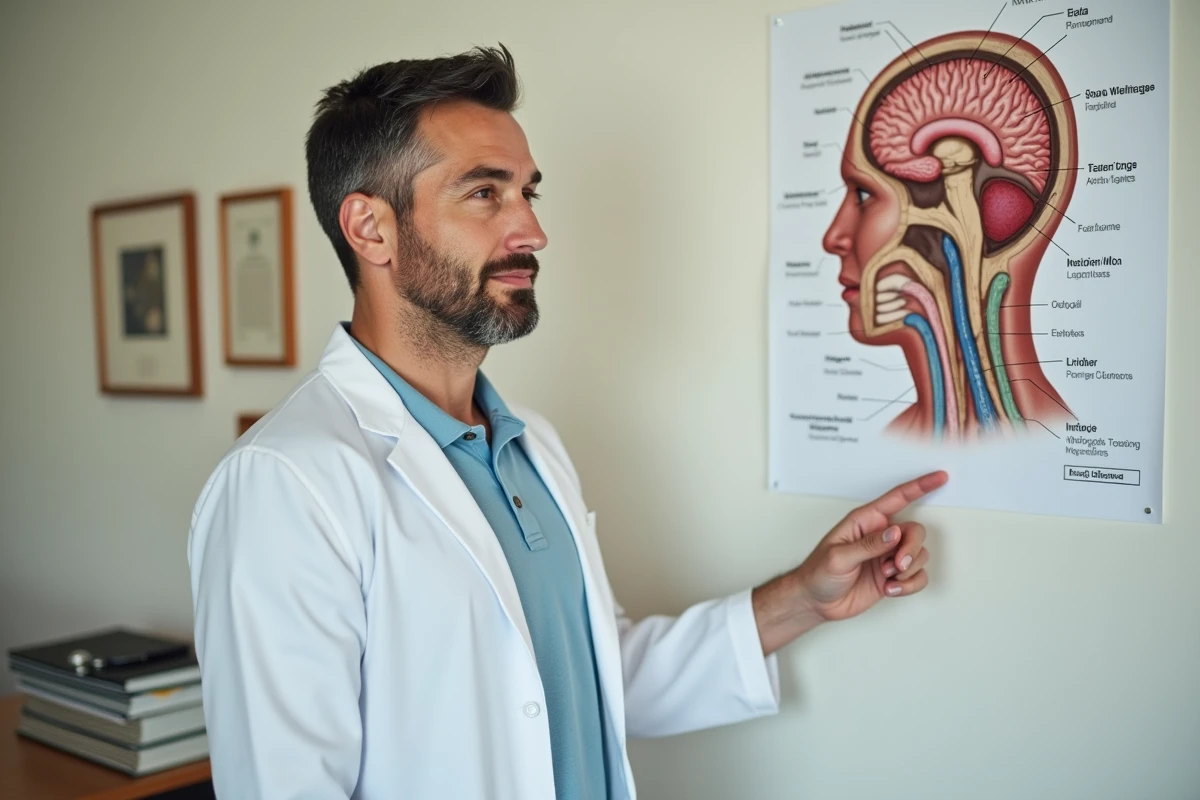
A KO, or knockout, refers to a loss of consciousness caused by a head injury. The brain, violently shaken inside the skull, experiences a temporary interruption of its normal electrical activity. This simple clinical definition masks a physiological reality with sometimes lasting consequences on neurological health and, by extension, on life expectancy.
Axonal Shearing: What Happens in the Brain During a KO
During a violent impact to the head, the brain does not just hit the skull. It undergoes a rotational movement that stretches and tears the axons, the extensions of neurons that transmit nerve impulses. This phenomenon, called diffuse axonal injury, damages brain connectivity on a microscopic scale.
Rotational movements are particularly destructive. A blow to the jaw, for example, causes the head to rotate and generates shear forces in the deep white matter of the brain. The damage is not always visible on a standard scan, which explains why some KOs appear “benign” even though they have caused real injuries.
To this mechanical injury is added a neurochemical cascade: massive release of neurotransmitters, influx of calcium into cells, local inflammation. These reactions worsen the initial damage in the hours and days following the impact. A second impact occurring before the complete resolution of this cascade can lead to disproportionate injuries relative to the force of the blow, a phenomenon recognized in sports medicine as second impact syndrome.
To better understand the potential danger of a KO, one must consider these invisible mechanisms as much as the loss of consciousness itself.
Repeated Micro-Traumas and Chronic Traumatic Encephalopathy
Recent medical data emphasize a point that changes the understanding of risk: the accumulation of head blows, even without loss of consciousness, poses a danger at least as serious as an isolated KO. Doctors now assess the overall history of exposure to impacts, including those received during training, rather than just counting the number of knockouts.

This chronic exposure promotes the development of chronic traumatic encephalopathy (CTE), a neurodegenerative disease characterized by the abnormal accumulation of tau protein in the brain. Symptoms often appear years, or even decades, after the end of a sports career.
CTE manifests through progressive disorders:
- Cognitive deficits: memory loss, difficulty concentrating, impaired judgment and reasoning
- Mood disorders: depression, irritability, impulsivity, sometimes aggressive behaviors
- Motor impairments: tremors, coordination problems, speech difficulties reminiscent of Parkinson’s disease
- In advanced stages, dementia comparable to Alzheimer’s disease
The formal diagnosis of CTE can currently only be confirmed through post-mortem examination of brain tissue. Several former professional boxers whose brains have been studied after their deaths exhibited characteristic lesions of this pathology.
Boxers’ Life Expectancy: What Available Data Shows
Discussions within the martial arts community report comparative analyses suggesting that boxers rank among the elite athletes with the lowest life expectancy. This observation, if confirmed on a large scale, points to a link between repeated head trauma and premature mortality.
Several mechanisms explain this potential excess mortality. CTE itself reduces autonomy and quality of life, but associated complications (dementia, severe depression, behavioral disorders) also increase the risk of indirect deaths. Chronic neurological impairments disrupt cardiovascular regulation and sleep, two factors recognized as influencing longevity.
A study conducted over twenty-five years by the Paris neuroimaging service in collaboration with the French Boxing Federation highlighted an aggravating factor related to fighting style. Among “stylish” boxers with good technique, the rate of cortical atrophy detected by MRI was significantly lower than that observed in “punchers” who absorb more blows. Thus, boxing style and the ability to avoid impacts directly modify long-term neurological prognosis.
Medical Protocol After a KO: French Rules Strengthened in 2026
The French Boxing Federation has updated its medical regulations for the 2026-2027 season, tightening the procedures to follow after a KO. The text now mandates a cessation of practice (“stop boxing”) for a variable duration depending on the severity of the episode, accompanied by a systematic neurological assessment and additional examinations before any resumption.
This strengthening reflects an institutional awareness. Previous practices, which often limited themselves to arbitrary rest of a few weeks, did not guarantee the complete resolution of brain injuries before returning to combat.
The current protocol includes:
- An obligatory neurological clinical examination within hours following the KO
- Brain imaging examinations (MRI) before any authorization to resume
- A minimum duration of prohibition from fighting, longer for professionals than for amateurs
- Close medical monitoring to detect any delayed symptoms
These measures apply to both amateurs and professionals. They reflect the evolution of knowledge regarding the brain’s vulnerability in the post-traumatic period, where a new shock can cause irreversible damage.

The health risks of a KO are not limited to the visible loss of consciousness in the ring. Axonal injuries, brain inflammation, and the silent accumulation of tau protein paint a pathological picture that may reveal itself decades later. The recent tightening of medical protocols in France shows that federations are gradually integrating this data, but the best protection remains the reduction of the total number of blows to the head, both in competition and training.